Quarter-driven
- Short-horizon decisions
- Strategy IS the company
- Values follow profitability
- Pivot when convenient
- Built to scale, then sell
by Jim Collins
Source book · ~6h read
“Visionary companies pursue a cluster of objectives, of which making money is only one — and not necessarily the primary one.”
The argument
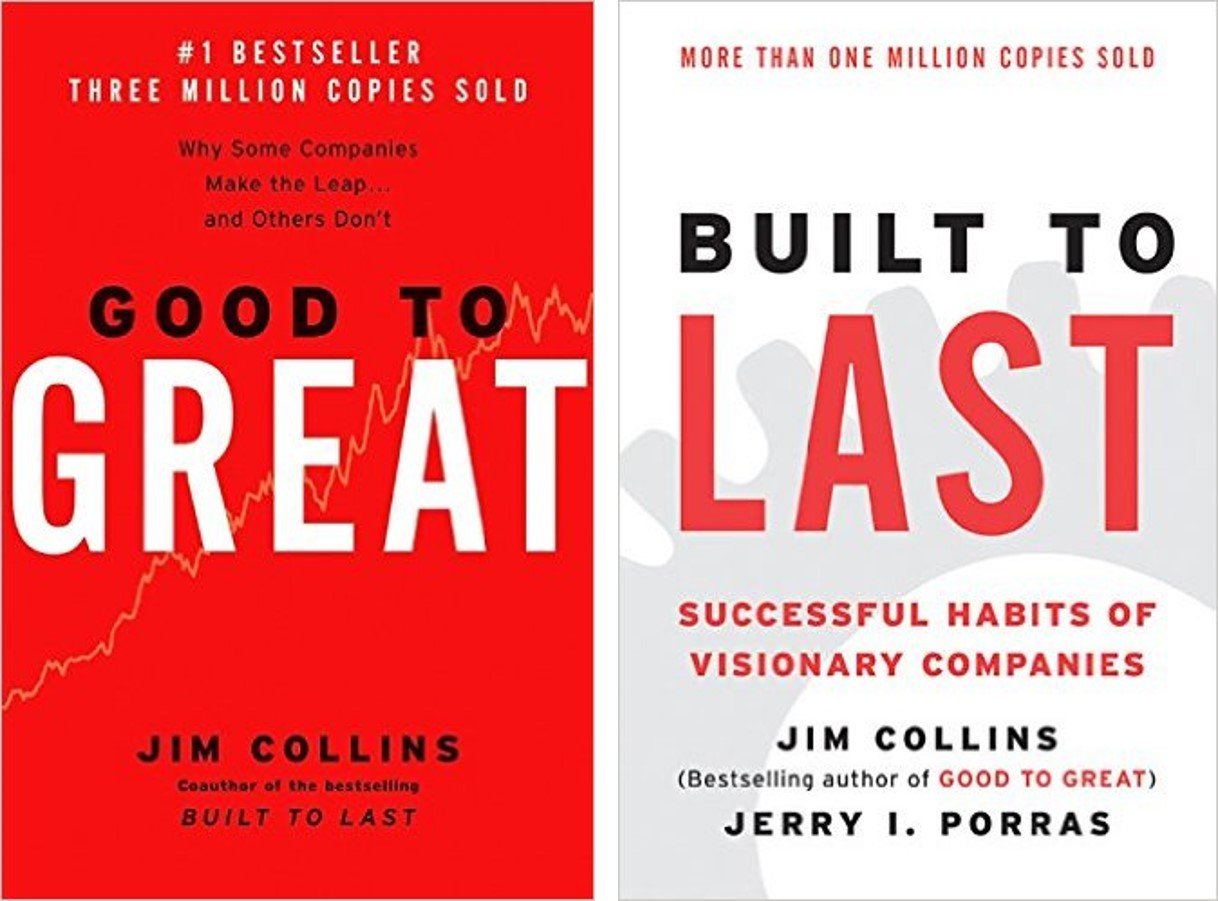
Jim Collins and Jerry Porras studied 18 visionary companies that lasted 50+ years and outperformed peers. The thesis: lasting companies aren't built around great ideas, charismatic leaders, or even product superiority — they're built around enduring core ideology preserved through changing strategy and tactics. The key concept: 'preserve the core, stimulate progress.' Core values and core purpose stay constant; everything else evolves.
At a glance
The hook
Lasting companies aren't built on better products. They're built on convictions that outlast the products.
Most first-time founders default to short-horizon thinking — runway, this quarter's metrics, the next milestone. That's necessary in survival mode. But Collins and Porras's contribution is showing that the companies that last decades operated with a 30-year horizon from year one. They knew what they would never change (the core ideology) and what they would always be willing to change (everything else).
For first-time founders the question isn't 'what's our 30-year vision?' (often premature) — it's 'what's the core ideology that, even at year 30, we wouldn't compromise?' Most founders haven't named this. The ones who do build companies that outlast them. Built to Last gives you the analytic framework — core values, core purpose, BHAGs, cult-like cultures, evolutionary progress — to design for endurance from day one.
0 takeaways
Block 60 quiet minutes. Answer two questions in writing:
Core values — What 3–5 values would I never compromise, even if they cost me money or growth?
Write them. Now stress-test each:
'If we discovered tomorrow that holding this value cost us 30% of our revenue, would we still hold it?'
If the answer is 'we'd reconsider,' that's not a core value — it's a strategy. Cross it out. The values that survive this test are core; everything else is negotiable.
Core purpose — Beyond making money, why does this company need to exist?
Not what we do — why we do it, in a way that would still be meaningful 100 years from now. 'To organize the world's information and make it universally accessible and useful' (Google) is a core purpose. 'Be the best CRM platform' is a strategy.
Core ideology = the values that survived stress + the purpose that survives 100 years. Now ask the founding team: do our daily decisions reflect this? If not, why not?
Read
Search Built to Last by Jim Collins on Amazon, your local bookshop, or your library system.
The loop closes here
When a founder applies an idea from Built to Last and something shifts, they post it as a Knack. Knacks tagged with this book surface here — practical, written by the people who lived it.
Open invitation
Did applying something from this book change a week, a decision, a meeting? Tell another founder. Even a small shift, written honestly, is the kind of Knack that gets marked “This worked” — and helps the next founder pick up the book and try it.
Pseudonymous by default. No humble-bragging — just here's what I tried, here's what shifted.
Share