Reactive
- 'Should I do X or not?'
- Confirm initial intuition
- Decide while feeling
- Commit blindly
- Find out late if wrong
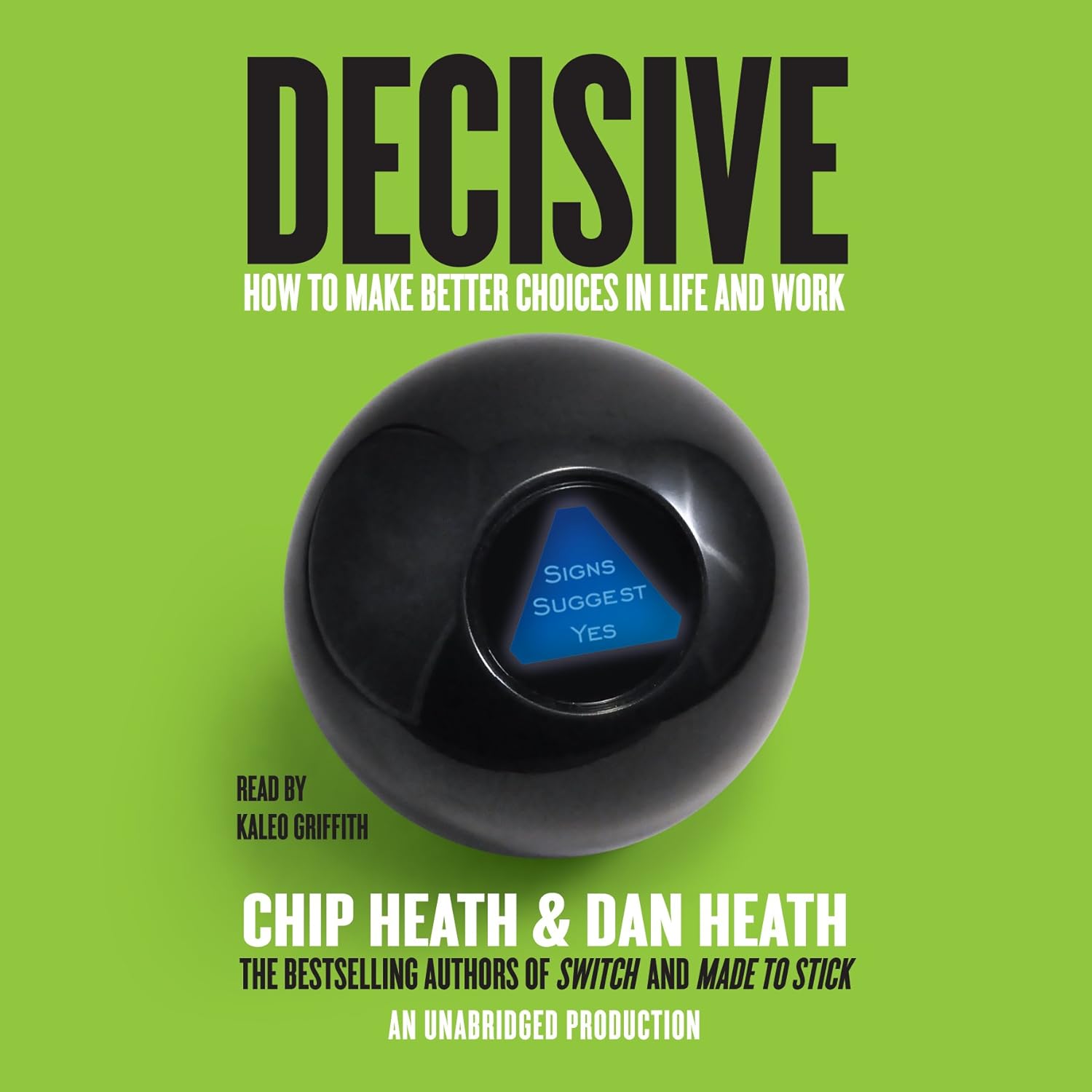
by Chip & Dan Heath
Source book · ~5h read
“We can't deactivate our biases, but we can counteract them with the right discipline.”
The argument
Chip and Dan Heath, after surveying decision research, identify four 'villains' that systematically corrupt decisions: narrow framing (limiting options to a binary choice), confirmation bias (seeking evidence for what we already believe), short-term emotion (deciding from temporary feelings), and overconfidence (assuming we know more than we do). The antidote is the WRAP framework: Widen your options. Reality-test your assumptions. Attain distance before deciding. Prepare to be wrong.
At a glance
The hook
The four villains of decision-making keep ambushing you in the same week.
Founders make consequential decisions weekly: should we hire this person, ship this feature, take this round, exit this customer. The Heath brothers show that even good intentions don't protect you from the four villains — they're cognitive biases, not character flaws.
The WRAP framework — Widen, Reality-test, Attain distance, Prepare to be wrong — is the structured antidote. Most founder decisions go straight from problem to solution without the four steps. Widening means generating real alternatives, not validating one option. Reality-testing means seeking disconfirming data, not confirmation. Attaining distance means using time, perspective, or external advisors to escape short-term emotion. Preparing to be wrong means acknowledging uncertainty in advance, not after the fact.
For first-time founders, the value is operational. Run any consequential decision through WRAP, and you'll catch most villains before they cost you. Most decisions feel like they require speed; in reality, they require structure.
0 takeaways
Pick one consequential decision you're facing this week — a hire, a strategic choice, a major customer ask.
Widen — List 3–4 real alternatives. Not 'do X or don't.' Genuinely different options. 'Do X with caveats. Do Y instead. Wait 30 days and reassess. Do nothing.'
Reality-test — What evidence would convince you the option you're leaning toward is wrong? Find that evidence before deciding. Run a small experiment if possible.
Attain distance — Use the 10/10/10 rule. How will you feel about this in 10 minutes? 10 months? 10 years? Different timescales reveal different aspects. Or: if a friend brought you this exact choice, what would you advise them?
Prepare to be wrong — Define what 'wrong' looks like. What signal would tell you the decision was bad? Set a check-in date. Pre-commit to a response if the signal arrives.
Now decide. The decision quality is dramatically higher because you've passed it through the four villains' antidotes. Run this on every consequential decision; the cost is 30 minutes, the benefit is years.
Read
Search Decisive by Chip & Dan Heath on Amazon, your local bookshop, or your library system.
The loop closes here
When a founder applies an idea from Decisive and something shifts, they post it as a Knack. Knacks tagged with this book surface here — practical, written by the people who lived it.
Open invitation
Did applying something from this book change a week, a decision, a meeting? Tell another founder. Even a small shift, written honestly, is the kind of Knack that gets marked “This worked” — and helps the next founder pick up the book and try it.
Pseudonymous by default. No humble-bragging — just here's what I tried, here's what shifted.
Share