Designer's view
- All info matters
- Users will read everything
- Conventions limit creativity
- More features = more value
- Tested with 'people in the field'
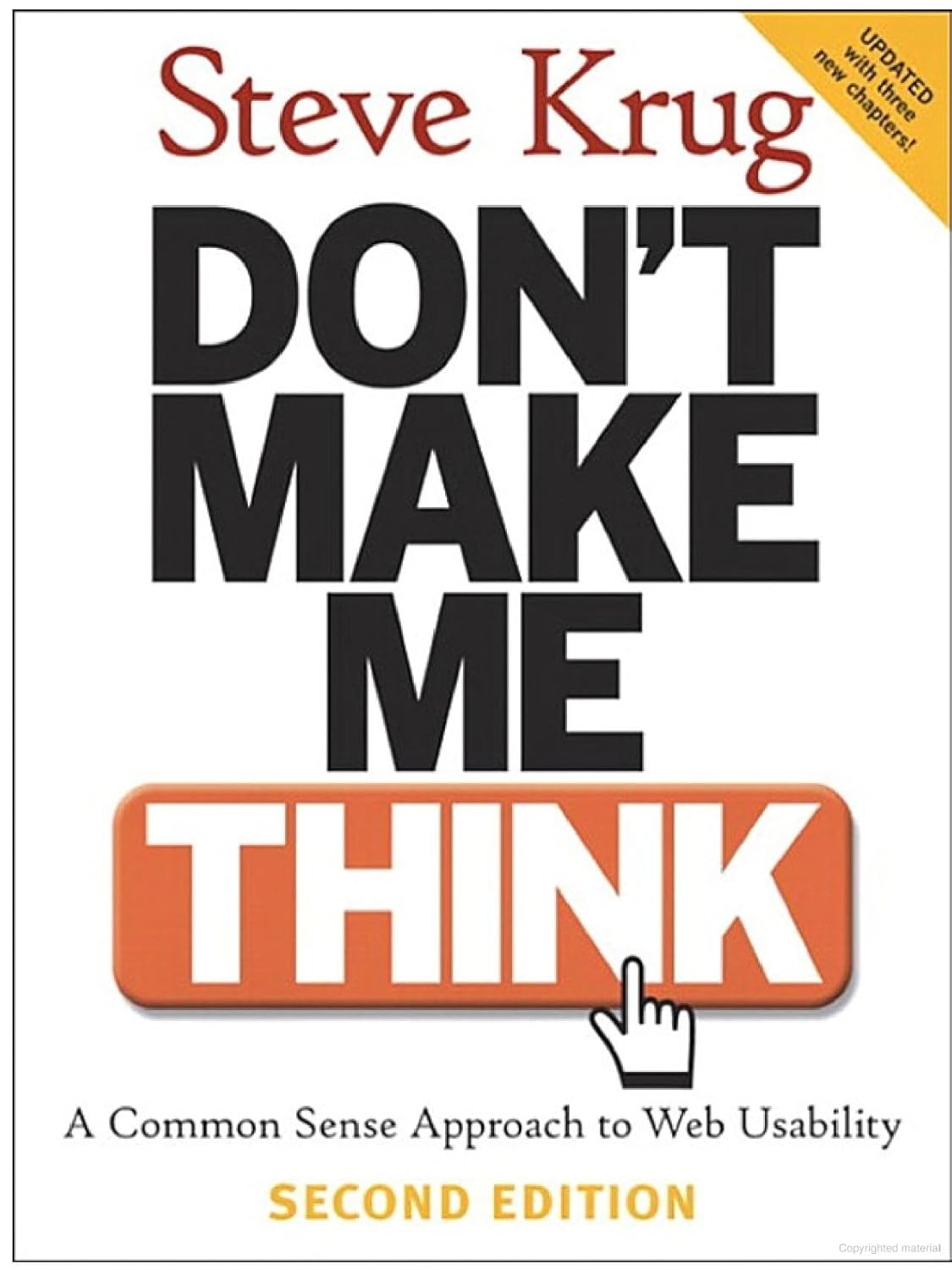
by Steve Krug
Source book · ~3h read
“If your audience is going to act like you're designing billboards, then design great billboards.”
The argument
Steve Krug argues that good UX has one job: don't make the user think more than they have to. Every cognitive friction point — confusing label, ambiguous button, hidden navigation — costs the user attention they don't owe you. Usable design is invisible; it gets out of the way and lets people do what they came to do.
At a glance
The hook
Most users won't tell you they're confused. They'll just leave.
First-time founders consistently overrate how much effort a user will spend to figure out their product. The user has 3 seconds, not 30 minutes. Krug's contribution is reframing usability from 'is it possible to do?' (yes — almost any UI is theoretically usable) to 'is the right path obvious within seconds?' (often no — and that's the gap that kills early adoption).
For a Phase 1 founder, this book is a recalibration. You'll stop adding features the moment you watch one user get confused by what you already have. The cost of fixing one confusing button is often greater than the value of the next feature on the roadmap. Krug gives you the language and the testing protocol — the cheap, fast usability test — to find the confusions before they cost users.
0 takeaways
Find someone who has never used your product. Could be a friend, a relative, an Uber driver, anyone. Doesn't need to be your target user — usability problems are universal.
Give them your homepage URL. Don't explain anything. Ask them three questions, in this order:
'What is this site? What does this company do?'
'If you wanted to ___ (your product's main use case), what would you click first?'
'Now actually try to ___. Talk out loud as you go.'
Time them. Don't help. Watch where they hesitate, look confused, click the wrong thing, or give up.
Every hesitation is a usability bug. *Don't dismiss it as 'they just didn't read carefully' — that's exactly Krug's point. Real users won't read carefully either.* Fix the top three confusions you saw before adding any new feature. Repeat the test every two weeks with a different person.
Read
Search Don't Make Me Think by Steve Krug on Amazon, your local bookshop, or your library system.
The loop closes here
When a founder applies an idea from Don't Make Me Think and something shifts, they post it as a Knack. Knacks tagged with this book surface here — practical, written by the people who lived it.
Open invitation
Did applying something from this book change a week, a decision, a meeting? Tell another founder. Even a small shift, written honestly, is the kind of Knack that gets marked “This worked” — and helps the next founder pick up the book and try it.
Pseudonymous by default. No humble-bragging — just here's what I tried, here's what shifted.
Share