Job
- Pays the bills
- Skills used, not loved
- Career, not vocation
- Retire-and-escape goal
- Decline accelerates with age
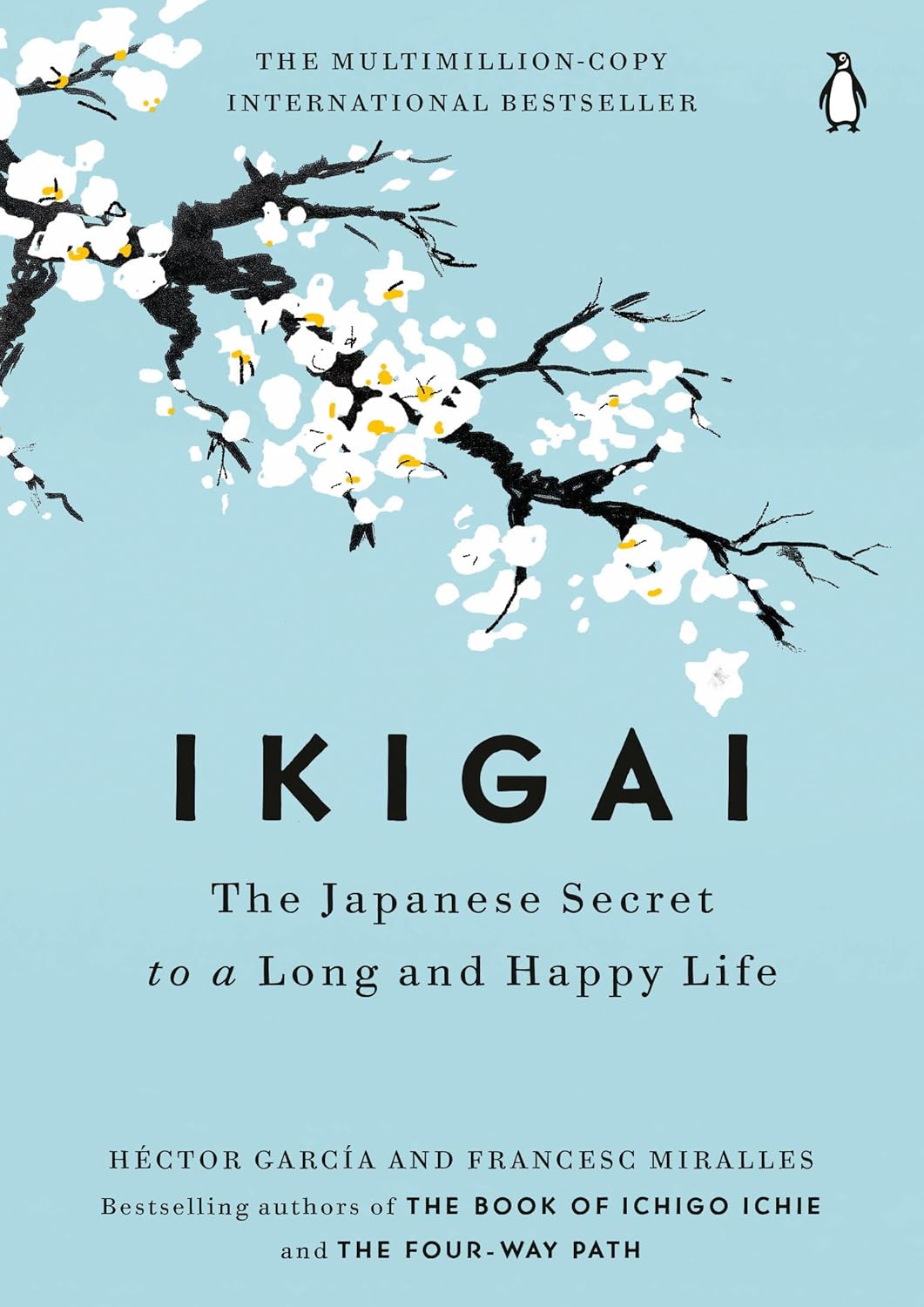
by Héctor García & Francesc Miralles
Source book · ~4h read
“Only staying active will make you want to live a hundred years.”
The argument
Héctor García and Francesc Miralles, after living and studying in Okinawa — home to one of the world's largest concentrations of centenarians — argue that *longevity correlates more with having a clear ikigai than with diet, exercise, or genetics. Ikigai (生きがい) is the Japanese concept of a reason for being — the intersection of what you love, what you're good at, what the world needs, and what you can be paid for*. The book is part travelogue, part philosophy: lessons from people who never retired because they never separated 'work' from 'life.'
At a glance
The hook
Most founders chase what's lucrative. The longest-running ones built around what they couldn't stop doing.
The Western frame splits work and life: career first, fulfillment later (or never). Ikigai rejects the split. The Okinawan elders García and Miralles interview don't 'retire' because they never had jobs separate from their lives — they had work that intersected what they loved, what they were good at, what their community needed, and what sustained them.
For first-time founders, the value is reframing the why-am-I-building-this question. If your venture only sits in the 'what can be paid for' circle, the work eats you over years. If it sits at the intersection of all four — what you love, what you're good at, what's needed, what's paid — the work feeds you back, even on hard weeks. Ikigai isn't a goal-setting framework; it's a diagnostic for whether the venture is sustainable on a 30-year horizon, for you specifically.
0 takeaways
Take 30 quiet minutes. Draw four overlapping circles. Label them:
What I love
What I'm good at
What the world needs
What I can be paid for
For each, list 3–5 specific items. Be honest, not aspirational. What I love isn't what you should love — it's what you actually return to.
Now look at your current venture. Which circles is it in?
If it's only in 'what I can be paid for' — that's a job, not an ikigai. The work will exhaust you over years.
If it's only in 'what I love' + 'what I'm good at' — that's a hobby, not a venture. The economic absence will exhaust you over years.
If it's in 3 circles — that's a sustainable career. You can do this for a long time.
If it's in all 4 — that's an ikigai. Defend it ruthlessly. It's rare.
If your venture is in fewer than 3 circles, the practice isn't to abandon it — it's to identify which circle is missing and ask why. Sometimes the venture can be reshaped to add a circle. Sometimes it can't, and that's information too.
Read
Search Ikigai by Héctor García & Francesc Miralles on Amazon, your local bookshop, or your library system.
The loop closes here
When a founder applies an idea from Ikigai and something shifts, they post it as a Knack. Knacks tagged with this book surface here — practical, written by the people who lived it.
Open invitation
Did applying something from this book change a week, a decision, a meeting? Tell another founder. Even a small shift, written honestly, is the kind of Knack that gets marked “This worked” — and helps the next founder pick up the book and try it.
Pseudonymous by default. No humble-bragging — just here's what I tried, here's what shifted.
Share