Without meaning
- 'This is meaningless suffering'
- Endurance feels arbitrary
- Future provides no anchor
- Days pass — get through them
- Hope = situation will improve
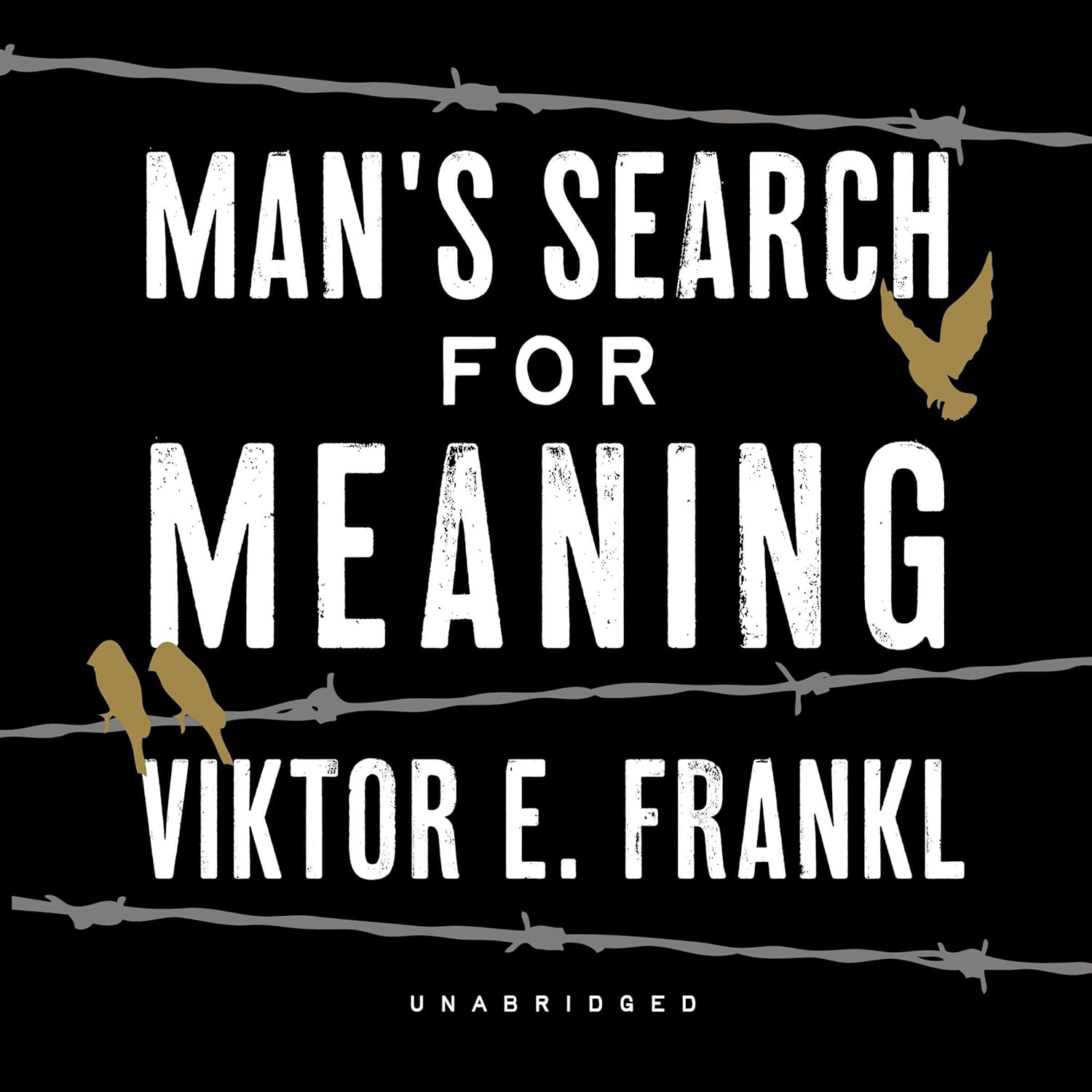
by Viktor Frankl
Source book · ~3h read
“The last of the human freedoms — to choose one's attitude in any given set of circumstances, to choose one's own way.”
The argument
Viktor Frankl, a psychiatrist who survived four Nazi concentration camps, argues that the primary motivational force in human beings is not pleasure (Freud) or power (Adler) but the search for meaning. Even in the most extreme suffering — the camps themselves — the people who survived weren't necessarily the strongest physically, but those who could find a why to live for. The book launches logotherapy: the school of psychology built around the idea that meaning is what makes the unbearable bearable.
At a glance
The hook
Frankl: meaning isn't a gift. It's a discovery you make in the act of suffering.
Founders are routinely told to find their why — but most of the WHY-discourse is Sinek-style: what does the company exist for? Frankl's WHY is different and deeper. It's the personal meaning you find for your own life — the reason you keep going on the worst week, when no one else would notice if you stopped.
For first-time founders, this distinction matters most when the company isn't going well. Strategy exhausts. Purpose endures. When the third launch fails, when a co-founder leaves, when you've gone six months without a meaningful win — what survives is not your business plan, your funding strategy, or your motivation. What survives is your reason for doing this in the first place — if you have one specific enough to hold onto. Frankl gives you the language and the historical proof that meaning, found and held, makes the unsurvivable survivable.
0 takeaways
On a hard week — not abstractly, on an actual hard week — sit alone for 20 minutes and ask:
*'What is this week asking of me?'*
Not 'why is this happening to me?' Not 'what should I do strategically?' The Frankl question is different: 'what response, on this week, would let me look back on this period as one I lived rather than endured?'
Three sources of meaning to consider:
Creation — what work or deed in front of me would make this week count? Not the most important strategic move; the most meaningful action.
Encounter — what person, conversation, or experience could anchor me this week? Who specifically? What would that conversation look like?
Attitude — what is unavoidable about this week, and what attitude toward it would let me carry it without bitterness?
Write down the answer. The point isn't to feel better immediately; it's to remember that even on the worst week, the choice of meaning is still yours. That choice, repeated through enough hard weeks, is most of what persistence actually is.
Read
Search Man's Search for Meaning by Viktor Frankl on Amazon, your local bookshop, or your library system.
The loop closes here
When a founder applies an idea from Man's Search for Meaning and something shifts, they post it as a Knack. Knacks tagged with this book surface here — practical, written by the people who lived it.
Open invitation
Did applying something from this book change a week, a decision, a meeting? Tell another founder. Even a small shift, written honestly, is the kind of Knack that gets marked “This worked” — and helps the next founder pick up the book and try it.
Pseudonymous by default. No humble-bragging — just here's what I tried, here's what shifted.
Share