Knots & Knacks
← Stories
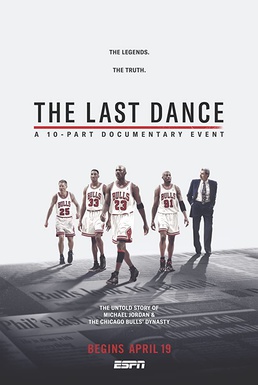
Poster for The Last Dance (2020)

The Last Dance

Directed by Jason Hehir

Documentary · 2020 · 1 seasons · ~8h total

Starring Michael Jordan, Scottie Pippen, Phil Jackson, Dennis Rodman.

Find streaming options ↗

Once you joined the team, you lived at a certain standard that I played the game. And I wasn't going to take anything less.
Michael Jordan, The Last Dance (2020)

The lens

A model

The argument

Central thesis

The Last Dance is the longest, most-detailed, real-life portrait on the shelf of what relentless excellence looks like at the level of practice — and what it costs. Jordan is six championships, but the documentary's editorial choice is to never show the trophies as the destination. The trophies are the byproduct. The destination — episode after episode — is the daily standard. Practice. The fight with Steve Kerr. The flu game. The shot over Russell. The freezer in his hotel room.

The cost is rendered in real time. Jordan's relationship with Jerry Krause. The team's exhaustion at the end. Phil Jackson's exit. Pippen's resentment. Horace Grant's bitterness. Every championship has a cost, paid by people who weren't on the trophy. The documentary's discipline is to show you both: the trophies and the relationships that paid for them.

For founders, The Last Dance is the longest case study available of the founder-as-relentless-one — what works about it, what it produces, and what it costs. Five hours of pure outcome; five hours of pure cost. The founder who pushes for excellence at this level builds extraordinary things. The founder also loses people. Both are true.

The hook

The founder lesson

Excellence at this level builds extraordinary things. Excellence at this level also loses people. The Last Dance refuses to let you choose between the two truths.

Three founder lessons.

First, the daily standard. Jordan's practice is more intense than anyone else's games. He punches Steve Kerr in practice. He berates Scott Burrell every day. He is not interested in being friends with the team; he is interested in winning championships, and the team's job is either to rise to the standard or be replaced. Founders who soften the standard for popularity build companies that lose to founders who don't. That's a structural truth. The Last Dance shows it.

Second, the cost of being the standard-bearer. Jordan doesn't have a private life that survives the work. He gambles. He alienates teammates. His relationships with Krause and with the version of himself that has to be Jordan-the-businessman are corroded. The post-championship retirements are partly about basketball; they're also partly about the impossibility of continuing to be that person. Founders carrying the standard for years pay this cost in body, marriage, friendships, sleep — and the cost is paid whether the championship arrives or not.

Third, Phil Jackson's leadership. This is the under-appreciated lesson. He doesn't manage Jordan; he manages the room around Jordan. The triangle offense, the meditation, the books he gave each player to read on road trips — Phil's job was to make a system in which Jordan's relentlessness produced championships rather than burned the team down. Founders who have a relentless person on the team — themselves or someone else — need a Phil. Someone who buffers, contextualizes, integrates the relentlessness into a system that doesn't break. Without Phil, Jordan's standard burns the team down. With Phil, it builds six championships in eight years.

0 takeaways

What to remember

    Practice CardOne-screen exercise

    Where do you set the standard, and where do you protect the people?

    Most founders pick one of two postures: push the standard at the cost of the people (Jordan without Phil), or protect the people at the cost of the standard (the soft team that doesn't ship). The Last Dance shows neither works alone.

    Take fifteen minutes. List the three areas of your business where you cannot soften the standard — product quality? cycle time? a specific customer commitment? response time on incidents?

    List the three areas where you must protect the people — rest? respect? psychological safety? family time? Friday afternoons?

    Decide explicitly which is which.

    The mistake isn't being relentless; it's being relentless about everything, or soft about everything. Re-do this list quarterly. Standards drift. Protection erodes. The discipline is naming both, before the team has to negotiate them under pressure.

    If you're the relentless one, the second exercise is: who's your Phil? If you don't have one, that's the highest-leverage hire you'll make for the next two years.

    Share with a founder who's deciding whether to keep going.