Knots & Knacks
← Stories
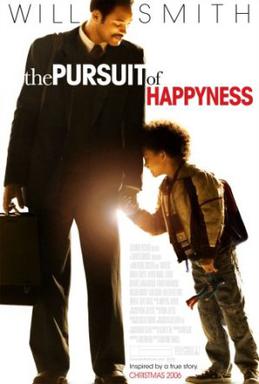
Poster for The Pursuit of Happyness (2006)

The Pursuit of Happyness

Directed by Gabriele Muccino

Film · 2006 · 1h 57m

Starring Will Smith, Jaden Smith, Thandiwe Newton.

Find streaming options ↗

You got a dream, you gotta protect it. People can't do somethin' themselves, they wanna tell you you can't do it. If you want somethin', go get it. Period.
Chris Gardner, The Pursuit of Happyness (2006)

The lens

A model

The argument

Central thesis

This is a real story rendered without flattering its subject. Chris Gardner is selling bone-density scanners that nobody wants. His marriage collapses. He sleeps in a subway bathroom with his five-year-old son. The film never gives him a break — every door that opens leads to another locked door — and the discipline is to never reward him with luck.

He earns the broker's spot by counting cold calls, by showing up clean when he's homeless, by choosing the unpaid internship anyway. The movie's most honest decision is that the conviction comes before any payoff. Gardner believes long before there's evidence to believe with. That's the founder's first season, rendered exactly as it feels.

The title's misspelling — Happyness, taken from a daycare wall in the film — is deliberate. Happiness isn't the destination. It's a misspelled word over a daycare door, glimpsed while running for the next door that might or might not open.

The hook

The founder lesson

Most founder narratives are written after the win. Pursuit shows the work before the win — in fine grain, when nothing has paid off and there's no guarantee anything will.

Several specific founder lessons.

First, counting. Gardner makes hundreds of cold calls — the book mentions 800; the film implies the discipline. The exact number doesn't matter. Counting itself matters. Counting turns anonymous failure into compounding evidence; founders who count their nos can keep going because the count is its own proof of work.

Second, showing up clean. Gardner sleeps in a subway bathroom and arrives at the brokerage the next morning in a clean suit. The dignity-of-the-showable-surface is one of the most underrated founder disciplines. When nothing else is going right, the showable surface still matters disproportionately — because it's what other people see, and what they see determines what they invest in.

Third, Christopher. The film's structural anchor isn't sentimental. Gardner is literally protecting his son while chasing a career. The son isn't motivation; he's structure. Founders who carry the work alone will eventually drop it. Founders who carry the work for someone — a child, a partner, a team — find they can hold weight they couldn't hold for themselves.

Fourth, the unpaid internship. Gardner takes the Dean Witter internship knowing it pays nothing, knowing twenty other interns are competing for one offer. The financial cost is real. The strategic logic is unyielding: the internship is the door, and the door is on the other side of the hopeless ratio. Founders who want to skip the hopeless ratio rarely get to the door.
0 takeaways

What to remember

    Practice CardOne-screen exercise

    Count your nos.

    Chris Gardner made 800 cold calls to land a broker seat. He didn't know how many it would take — he kept counting because counting itself turned anonymous failure into compounding evidence.

    Pick one discipline this week that you can count. Customer interviews. Cold emails. Knots posted. Investor outreaches. Reps in the gym. One specific countable action.

    Every Friday, write the number on a piece of paper and pin it somewhere you'll see it. The number is not the success metric — it's the consistency proof. When the day comes that you ask whether to keep going, the count answers.

    If your count drops below your weekly minimum twice in a row, that's the signal — not to quit, but to ask why the discipline broke before you ask whether the goal is wrong.

    Share with a founder who's deciding whether to keep going.