Knots & Knacks
← Stories
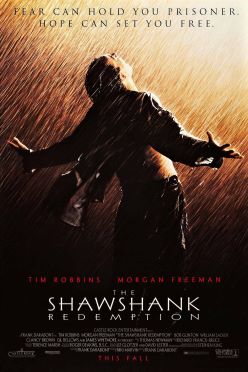
Poster for The Shawshank Redemption (1994)

The Shawshank Redemption

Directed by Frank Darabont

Film · 1994 · 2h 22m

Starring Tim Robbins, Morgan Freeman.

Find streaming options ↗

Get busy livin', or get busy dyin'.
Andy Dufresne (Tim Robbins), The Shawshank Redemption (1994)

The lens

A model

The argument

Central thesis

Shawshank is the long film about the long arc. Andy Dufresne is sentenced to two consecutive life terms for a crime he didn't commit. The film does not give him a break. He is beaten, exploited, brutalized, betrayed. Through all of it, he persists in two specific disciplines: building things (the library, the financial expertise, the rooftop beers, the warden's tax returns) and not surrendering the inside (his mind, his hope, his patience).

The escape — twenty years of carving a tunnel with a rock hammer he hides behind a Rita Hayworth poster — is the film's metaphor turned literal. Patience converts a small daily action into transformation, given time. The institution can take everything except the daily action. Andy spends two decades on his.

For founders, Shawshank is the long-haul film. Most founder failures aren't dramatic — they're cumulative surrender across years of small giving-up. The film's argument is that the discipline of small daily action, held without expectation of immediate result, is the only force strong enough to outlast institutional weight.

The hook

The founder lesson

Most founder failures aren't dramatic. They're cumulative surrender. Shawshank is the film about the long discipline that doesn't surrender.

The two disciplines Andy holds — building and not surrendering the inside — are the founder's daily disciplines, dressed in prison clothes.

Building is the daily reps regardless of whether anyone notices. The library, the financial books, the rock hammer. None of them pay off in real time. All of them compound. Founders who only build when they have an audience never build the long thing. The work that earns a launch event is downstream of years of work that earned no audience.

Not surrendering the inside is harder. The institution — whether a prison or a market — is structured to grind down belief. Andy's belief isn't optimism — it's a specific kind of seeing. The walls are real. The years are real. The cost is real. AND I am not what they say I am. That's the founder's belief on the worst weeks. Not denial; recognition with refusal.

Particularly: the rooftop beers scene. Andy negotiates beers for his work crew during tax season for the guards. The beers don't matter. The act of negotiation matters. It's a small refusal to be only what the institution says you are. Founders find these small refusals daily — a feature shipped over a board's objection, a hire made against a recruiter's ranking, a pricing decision made on conviction. They accumulate into identity.

The opera scene is the most-quoted moment about beauty. Andy locks himself in the warden's office and plays The Marriage of Figaro over the prison loudspeakers. He gets two weeks in solitary. Red asks if it was worth it. "Two weeks in the hole? Easiest time I ever did. Had Mr. Mozart to keep me company." For founders, this is the discipline of letting beauty into the place that's designed to deny it. The institution can't take what you let in.
0 takeaways

What to remember

    Practice CardOne-screen exercise

    Pick your rock hammer.

    Andy's escape took twenty years of one specific daily action. Pick your rock hammer: a single small daily action that would, if held for a decade without expectation, transform something specific in your company or yourself.

    Writing a paragraph a day. A 30-minute walk where you only think about one open question. One customer conversation a week. One Knot posted. One interview transcript reviewed. One uncomfortable email sent.

    The exercise isn't to start grand; it's to start specific. Pin it. Track it. Don't measure outcomes — measure showing up.

    After ninety days, re-evaluate the rock hammer; replace it if needed. The work isn't this rock hammer; it's being a person who has one.

    If you skip three days in a row, that's data — start again on day four; don't backfill, don't catastrophize, don't quit. *Andy's discipline wasn't perfection; it was return.***

    Share with a founder who's deciding whether to keep going.