Brand as vibe
- Colors, fonts, tone
- Expand to capture more
- Generic positioning
- Brand drifts over time
- Customer can't summarize
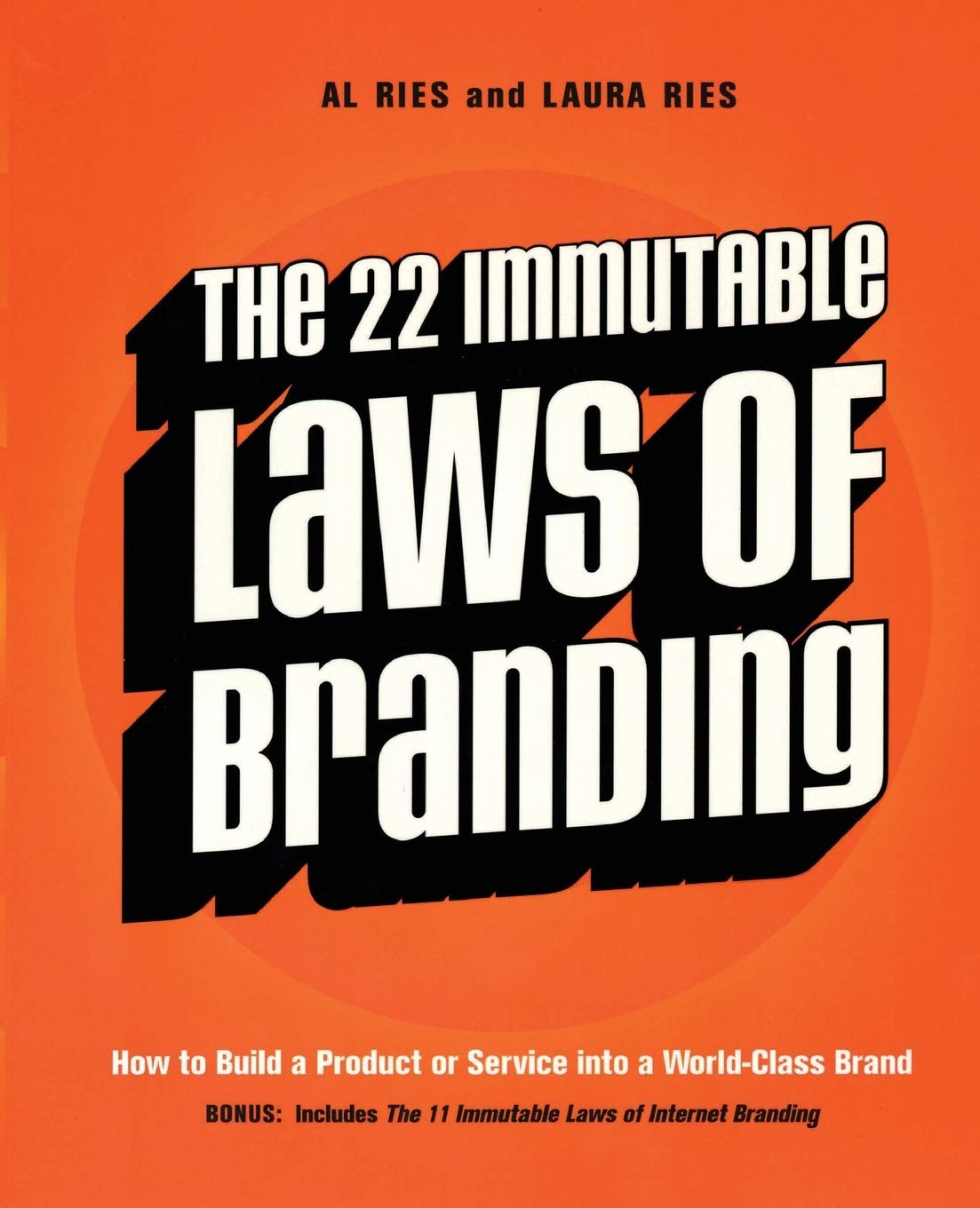
by Al & Laura Ries
Source book · ~5h read
“What's a brand? A singular idea or concept that you own inside the mind of the prospect.”
The argument
Al and Laura Ries, brand strategists, argue that branding follows discoverable rules that, when violated, destroy the brand even if the company succeeds in other ways. The 22 laws — expansion, contraction, publicity, advertising, the word, credentials, quality, category, name, extensions, fellowship, generic, company, subbrands, siblings, shape, color, borders, consistency, change, mortality, singularity — are mostly counterintuitive. The most counterintuitive: most companies destroy their brand by trying to expand it; the strongest brands are built by contraction.
At a glance
The hook
'Brand' feels like a vibe. The Ries make it a discipline.
First-time founders treat brand as a vibe — colors, fonts, tone of voice, vibes. The Ries argue that brand is something more rigorous: it's the word in the customer's mind that the company occupies, and the activities that protect or expand that word.
The book is opinionated and at times oversimplified, but for first-time founders the dogma is useful — it forces clarity over hedging. The most consequential law: the law of contraction. A brand becomes stronger when its scope is narrower. Most founders try to expand the brand to capture more customers; the result is brand dilution — the customer can't articulate what the company stands for. Contraction means picking a specific position and defending it ruthlessly. Volvo = safety. FedEx = overnight. Google = search.
For first-time founders, this book provides constraints that prevent the most common branding mistakes — overextension, name confusion, sub-brand proliferation. The constraints feel restrictive; the result is a brand the customer can actually remember.
0 takeaways
Pick a clean piece of paper. In one word, write what your company stands for in the customer's mind.
Not what you do — what you stand for.
Volvo: safety. Tesla: future. Stripe: developers. Patagonia: responsibility.
What's yours?
If you wrote multiple words — cross out the lesser ones until one remains. If you can't reduce to one — you don't have a brand position yet; you have a description.
The harder test: would your customers, asked the same question, write the same word?
If no — your brand intent doesn't match perception. The fix isn't more marketing; it's deciding whether to recommit to the intended word, or accept the word the market gave you and build from there.
The hardest test: for the next quarter, every product decision passes through one filter: 'does this strengthen our word, or dilute it?' Decisions that dilute, refuse — even if they'd grow revenue short-term. That refusal is the discipline of brand.
Read
Search The 22 Immutable Laws of Branding by Al & Laura Ries on Amazon, your local bookshop, or your library system.
The loop closes here
When a founder applies an idea from The 22 Immutable Laws of Branding and something shifts, they post it as a Knack. Knacks tagged with this book surface here — practical, written by the people who lived it.
Open invitation
Did applying something from this book change a week, a decision, a meeting? Tell another founder. Even a small shift, written honestly, is the kind of Knack that gets marked “This worked” — and helps the next founder pick up the book and try it.
Pseudonymous by default. No humble-bragging — just here's what I tried, here's what shifted.
Share