Lone genius pose
- Wait for inspiration
- Innovation feels random
- Critique kills early ideas
- Solo work
- Quality over quantity
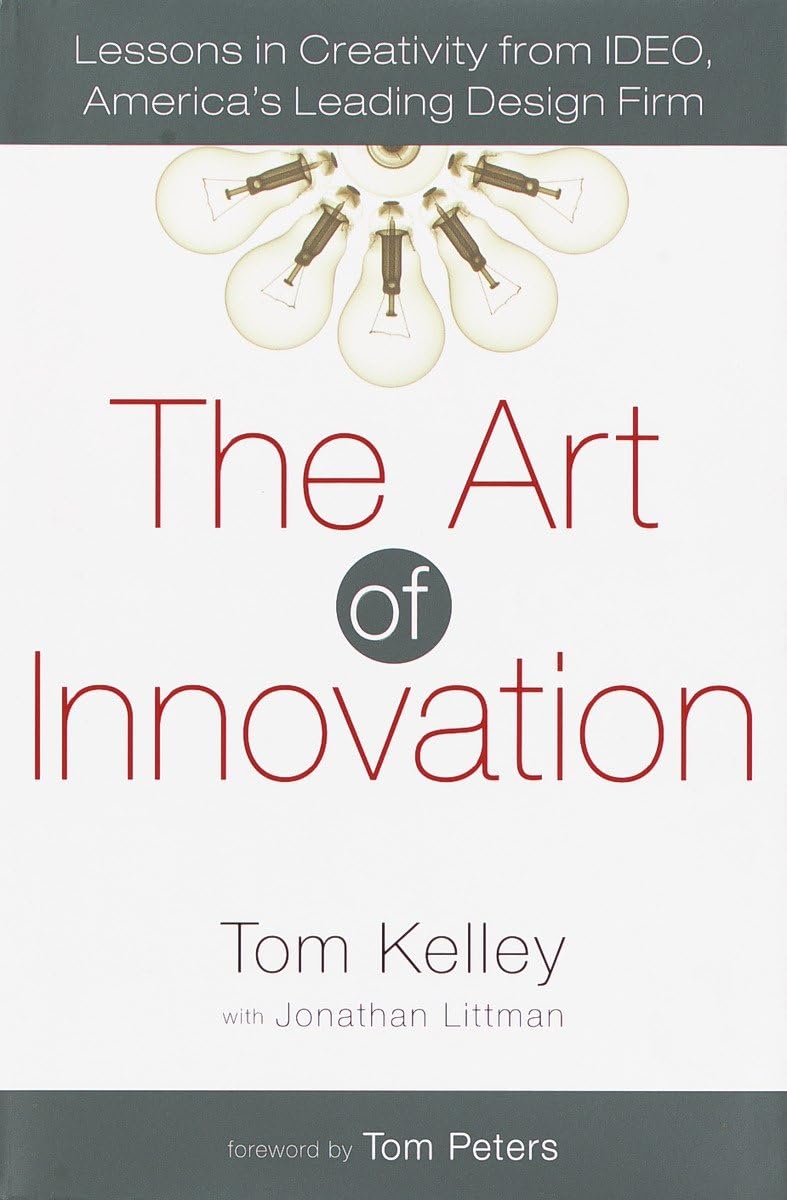
by Tom Kelley
Source book · ~5h read
“Enlightened trial and error succeeds over the planning of the lone genius.”
The argument
Tom Kelley, IDEO's general manager, argues that innovation is not the product of individual genius — it's the result of a disciplined, observable, replicable process. The process: observation in context, brainstorming with rules, rapid prototyping, cross-functional teams, fast iteration. Most companies treat innovation as a mystical event; IDEO treats it as a method. The book is part case study, part operating manual.
At a glance
The hook
Creativity feels like a personality trait. Kelley shows it's a process.
Many first-time founders outsource creativity to a co-founder they assume is 'the creative one,' or they suffer privately because they think they're not creative enough. Kelley's contribution is dismantling the assumption. Innovation is observable, decomposable, and trainable — and the book shows specifically how, with rules.
The brainstorming rules alone are worth the read: defer judgment, encourage wild ideas, build on the ideas of others, stay focused, one conversation at a time, be visual, go for quantity. These aren't pleasantries; they're rules that, when violated, kill the brainstorm.
For first-time founders, this book makes innovation operational. Schedule observation hours. Run brainstorms by the rules. Prototype quickly. Bring in a cross-functional team early. The output isn't always brilliant; it's reliably better than what comes from the lone-genius pose. Reliable beats brilliant over a quarter.
0 takeaways
Pick one product or strategy problem you've been talking about for weeks without resolution. Schedule a 60-minute brainstorm with 3–5 cross-functional people.
Print the rules and read them aloud at the start:
Defer judgment — no criticism during the session, even of bad ideas.
Encourage wild ideas — the wilder the better. Wild ideas can be tamed; tame ideas can't be wilded.
Build on others — 'Yes, and...' not 'no, but...'
Stay focused — one topic; resist drift.
One conversation — no side conversations.
Be visual — draw, don't talk. Whiteboards, sticky notes.
Go for quantity — 100 ideas in 60 minutes. Quality emerges from quantity.
Run the session. Don't critique during it. Save evaluation for the next day.
The results will be 80% noise. The 20% signal is more than you'd have generated alone. That's the point — Kelley's method, applied weekly, compounds.
Read
Search The Art of Innovation by Tom Kelley on Amazon, your local bookshop, or your library system.
The loop closes here
When a founder applies an idea from The Art of Innovation and something shifts, they post it as a Knack. Knacks tagged with this book surface here — practical, written by the people who lived it.
Open invitation
Did applying something from this book change a week, a decision, a meeting? Tell another founder. Even a small shift, written honestly, is the kind of Knack that gets marked “This worked” — and helps the next founder pick up the book and try it.
Pseudonymous by default. No humble-bragging — just here's what I tried, here's what shifted.
Share