Dip (push through)
- Difficulty is intrinsic
- Pushing harder compounds
- Breakthrough is on the other side
- Best-in-niche is the reward
- Most quitters quit here
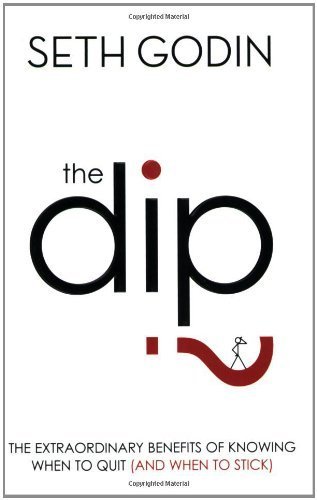
by Seth Godin
Source book · ~1h read
“Quit the wrong stuff. Stick with the right stuff. Have the guts to do one or the other.”
The argument
Seth Godin argues that most ventures hit a 'Dip' — a long, painful, mediocre stretch between starting and breakthrough. The Dip is where most people quit; those who push through find that the breakthrough lies on the other side of the Dip. But not every Dip ends in breakthrough — some lead to dead ends or cul-de-sacs. The strategic skill isn't pushing through everything; it's knowing which Dips to push through and which to quit.
At a glance
The hook
'Should I quit?' is the only question that matters this week.
Most first-time founders confuse two questions: *'should I quit because this is hard?' (almost always no) and 'should I quit because this is a dead end?' (sometimes yes). Godin's contribution is naming the difference.*
The Dip is the gap between the excitement of starting and the eventual mastery / market success. It's painful, mediocre, slow. Most quitters quit in the Dip — and miss the breakthrough that was 6 months away. But equally, some quitters keep going through what's actually a cul-de-sac (a path that doesn't end in breakthrough at all) — and miss the right move, which was to quit and start something else.
For first-time founders, the practical question is: am I in a Dip or a cul-de-sac? Godin's diagnostic: if pushing harder would actually compound, you're in a Dip — push through. If pushing harder produces the same mediocre result, you're in a cul-de-sac — quit. The willingness to quit strategic things is itself a competitive advantage; most founders can't.
0 takeaways
Take 30 quiet minutes. Answer in writing about your current major project or venture:
1. Is this hard because it's a Dip, or because it's a dead end? A Dip's hardness is intrinsic to the difficulty of the breakthrough — early scaling, customer acquisition learning curves, market education. A cul-de-sac's hardness is structural — the market is wrong, the unit economics are wrong, the channel doesn't exist, the product solves a non-problem.
2. If I push twice as hard for 6 more months, what specifically would change? Be concrete. If the answer is 'we'd be the best in our niche' — that's a Dip. If the answer is 'we'd still be where we are, just more exhausted' — that's a cul-de-sac.
3. Have I made structural changes recently, or just tactical ones? Tactical changes within a cul-de-sac don't help. If the last 90 days were tactical and nothing moved, the structure itself is the problem.
4. If I quit today and started something else, would I regret the quit or the time spent? If the regret is the quit — push through the Dip. If the regret is the time spent — the cul-de-sac was clear earlier than I admitted.
The willingness to honestly answer #4 is the strategic skill. Most founders avoid the question; the ones who answer it honestly compound.
Read
Search The Dip by Seth Godin on Amazon, your local bookshop, or your library system.
The loop closes here
When a founder applies an idea from The Dip and something shifts, they post it as a Knack. Knacks tagged with this book surface here — practical, written by the people who lived it.
Open invitation
Did applying something from this book change a week, a decision, a meeting? Tell another founder. Even a small shift, written honestly, is the kind of Knack that gets marked “This worked” — and helps the next founder pick up the book and try it.
Pseudonymous by default. No humble-bragging — just here's what I tried, here's what shifted.
Share