Committee-designed
- Average user feedback
- Soft decisions, many compromises
- No point of view
- Product loses shape
- Safe, forgettable result
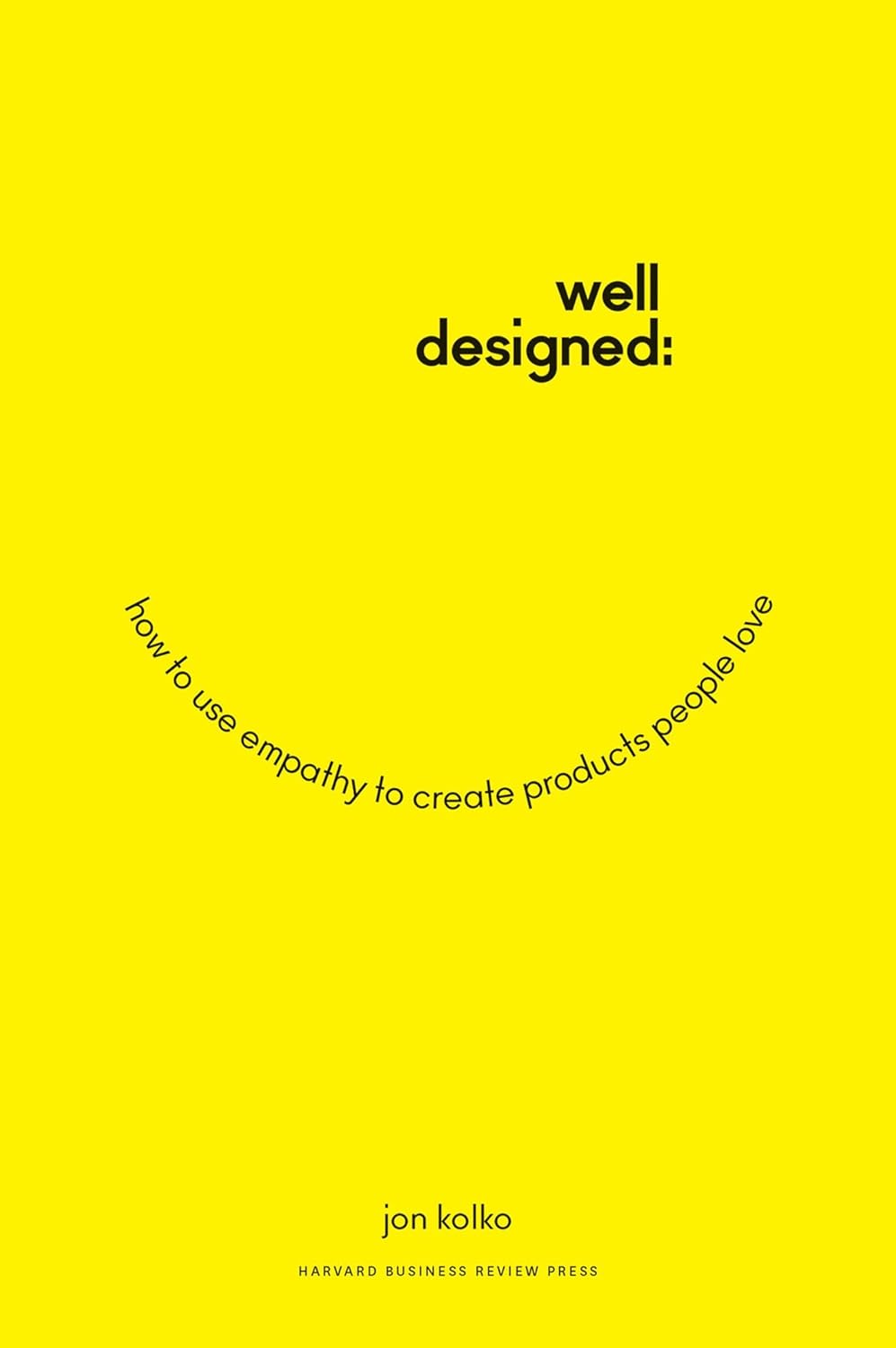
by John Kolko
Source book · ~4h read
The argument
John Kolko argues that the best products emerge when designers (and founders) approach product as a problem of empathy plus opinion. Empathy — deep understanding of user behavior, frustrations, and unmet desires. Opinion — a strong, point-of-view-driven response that the designer is willing to defend. Most products fail by under-doing one of the two: either over-empathized (committee-designed, no point of view) or under-empathized (founder ego masquerading as vision).
At a glance
The hook
Designing for users keeps becoming designing by committee.
First-time founders fall into two design traps. Trap 1: design by committee. They interview enough users that they end up trying to please everyone — and the product loses its shape. Trap 2: design by ego. They have a strong vision, ignore user behavior, and ship something the founder loves but no one else uses.
Kolko's contribution is the synthesis: deep empathy + strong opinion. Empathy means actually understanding user behavior — beyond what they say, into what they do and why. Opinion means a founder-led point of view that synthesizes the empathy into a specific recommendation, defended even when committee voices push back.
For first-time founders, this is the cure for over-iteration. You can't build a great product by averaging user feedback; you build it by understanding deeply, then committing. Average products are over-empathized; great products are deeply empathized + opinionated.
0 takeaways
Pick a product decision you've been waffling on. Probably a feature, a pricing question, a UX choice.
Step 1 — Empathy. Spend 2 hours doing customer observation in context. Watch them use the product (or its substitute). Don't ask leading questions; observe.
After the observation, write down:
What did I see them do that they didn't tell me about?
Where did they hesitate, work around, or get frustrated?
What hidden need is showing up that they haven't named?
Step 2 — Opinion. Now form a strong point of view about what should be done. Not 'we should consider doing X.' *A definitive: 'We should do X, because the empathy data shows Y.'***
Step 3 — Defend. Bring it to your team and defend the opinion against pushback. Resist the pull toward a softer, average decision.
The output isn't always right. But it's a coherent point of view, deeply rooted in user behavior, willing to be wrong on the way to being right. That's the kind of product decision that builds shape over months.
Read
Search Well-designed by John Kolko on Amazon, your local bookshop, or your library system.
The loop closes here
When a founder applies an idea from Well-designed and something shifts, they post it as a Knack. Knacks tagged with this book surface here — practical, written by the people who lived it.
Open invitation
Did applying something from this book change a week, a decision, a meeting? Tell another founder. Even a small shift, written honestly, is the kind of Knack that gets marked “This worked” — and helps the next founder pick up the book and try it.
Pseudonymous by default. No humble-bragging — just here's what I tried, here's what shifted.
Share